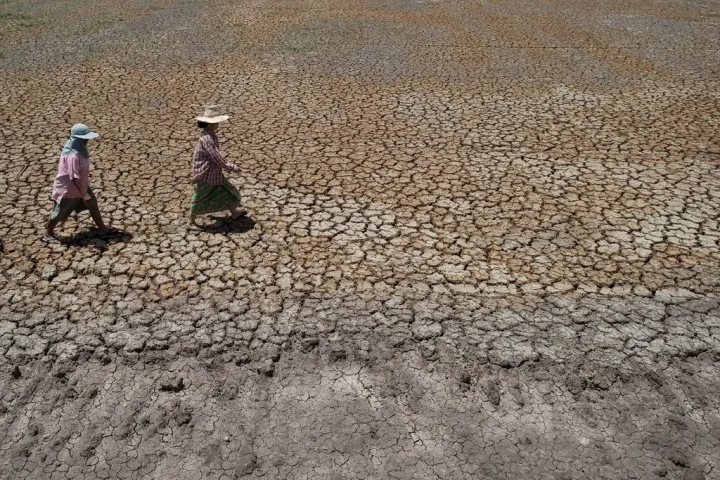
A post shared on Twitter claimed that poor countries are not harmed by climate change.
“No poor country has been harmed by climate change,” reads a Twitter post shared by @SteveMilloy, a self-acclaimed “climate science contrarian”.
No poor country has been harmed by 'climate change'… the Maldives, e.g., has actually gained land area since 2000.
These scoundrels aim to use the climate hoax as an excuse to get out of debt repayment… leaving US taxpayers on the hook. https://t.co/oe8sDdG6Mh
— Steve Milloy (@JunkScience) October 15, 2022
“These scoundrels aim to use the climate hoax as an excuse to get out of debt repayment… leaving US taxpayers on the hook,” the post added.
The post gathered over 170 retweets and over 400 likes.
The post was shared alongside a news report in New York Times with the headline, “20 Nations at High Risk From Global Warming Might Halt Debt Payments”. The report analysed the request for debt cancellation by some vulnerable countries.
“Twenty countries most vulnerable to climate change are considering halting their repayment of $685 billion in collective debt, loans that they say are an injustice,” Mohamad Nasheed, the former president of the Maldives, was quoted as saying in the New York Times.
The countries requested debt relief so the funds can be invested in climate projects or debt-for-nature swaps as it is called, a situation where part of a nation’s debt is forgiven and invested in conservation.
In the same report posted by the Twitter user, Nasheed explained that poor nations are locked in a “Sisyphean trap” where they must borrow money to ward off rising seas and storms, only to see climate-related disasters destroy the achievements made, hence, leading to a renewed cycle of borrowing.
“We are living not just on borrowed money but on borrowed time. We are under threat, and we should collectively find a way out of it,” Nasheed, the first democratically elected president of the Maldives had said.
But how accurate is the argument that poor countries are not affected by climate change; and the claim that climate issues are only being used as a false means to get out of debt repayment?
VERIFICATION
Adequate scientific research has established that climate change is real and is responsible for extreme weather events, such as heat waves, storms and floods. These harsh conditions like flooding and drought are disrupting agriculture, hence threatening food security globally.
According to the World Health Organisation (WHO), climate change has increased the occurrence of water- and vector-borne diseases and mental health issues. Though the effect of climate change differs for countries and regions, climate-related devastation threatens the entire human existence, with no exceptions for poor nations.
For instance, the 2022 flooding in Nigeria which affected over 3.2 million people, actually led to the death of over 600. The disaster has been recorded as the country’s most severe flooding disaster since 2012.
According to UNICEF, the flood disaster which affected 34 out of the 36 states in the country, displaced 1.3 million people and over 200,000 houses were either partially or fully damaged.
LOSS AND DAMAGE FUND FOR VULNERABLE COUNTRIES
At the recent United Nations Climate Change Conference – COP 27 in Sharm el Sheikh, the loss and damage fund was finally established to compensate developing countries most hit by the adverse effects of climate change.
The fund was agreed upon by over 190 countries at the closing plenary of the conference in Egypt.
It was concluded by the agreeing parties that the fund will be part of a broader funding arrangement, where sources will include funding aside from the UN climate change process, such as donor contribution, insurance, oil and gas tax, and debt relief.
The establishment of the loss and damage fund targeted at aiding the recovery of vulnerable countries suffering the worst impacts of climate disasters negates the claim that climate change does not affect poor countries.
The United States, Europe and the world’s wealthiest nations have emitted the highest volume of greenhouse gasses, and as a result, are disproportionately responsible for global warming. As a matter of fact, a continent like Africa is already facing more severe climate change than most other parts of the world, despite being the least responsible for the climate challenge.
To buttress the fact that developed nations are the huge contributors to global warming, President Muhammadu Buhari said in a recent op-ed that “Africa is not the problem”, adding that “Africa didn’t cause the mess, yet we pay the price”.
In the same op-ed published in Washington Post, Buhari said “if Africa were to use all its known reserves of natural gas — the cleanest transitional fossil fuel — its share of global emissions would rise from a mere 3 per cent to 3.5 per cent.”
The 2020 climate risk index presented at the United Nations Conference on Climate Change (COP 25) in Madrid revealed that some of the poor countries most affected by climate change include the Philippines, Madagascar, Sri Lanka, Kenya, and Rwanda amongst others.
Also, a 2021 report by the New York Times expressed that over the past 170 years, wealthy nations like the United States, Canada, Japan and the bulk of western Europe account for 12 per cent of the global population, and are “responsible for 50 per cent of all the planet-warming greenhouse gases released from fossil fuels.”
VERDICT
The claim that climate change is a hoax and that it doesn’t affect poor countries is absolutely false. In fact, evidence shows that developing nations are the most affected by climate change despite being the least responsible for the challenge.
This fact check was produced by TheCable with support from Code for Africa’s PesaCheck, International Fact-Checking Network, and African Fact Checking Alliance network.